


JAÉN REWIRED: How Smart Tech Is Transforming the Sea of Olives
Smarter water. Better decisions. A future worth growing.
How a real farm in Arquillos connects sensors, people and the next generation of rural skills.
Educational adaptation and commentary by Manuel Molina · Based on reporting by Teresa del Sol / Jaén Hoy · 7 November 2026.
Three ideas to take away

1. The future is growing beneath our feet
An olive grove may look quiet from the road. Under the surface, however, water is moving, roots are responding and conditions are changing. A farmer has to decide what to do before every consequence becomes visible. What if the next useful innovation were not a robot replacing a farmer, but a clearer view of what the field needs?
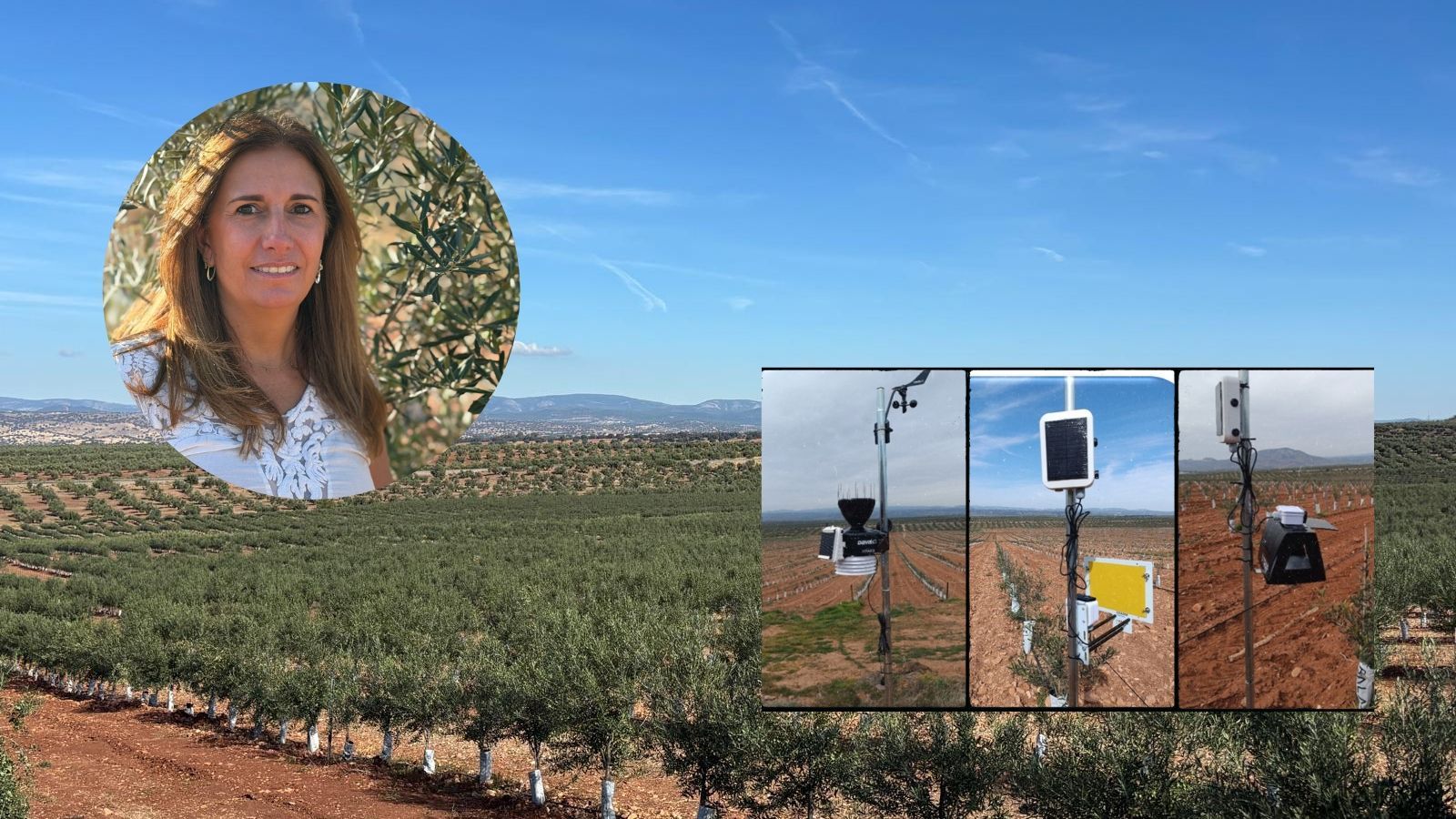
At Las Manillas, in Arquillos, technology is helping people ask better questions. In her report for Jaén Hoy, published on 7 November 2026, journalist Teresa del Sol describes a 90-hectare high-density olive grove using sensors, digital traps, weather monitoring and machinery data. Beatriz Castilla, a partner and the person responsible for the farm, explains the ambition: turn information into decisions that use resources more efficiently. [1]
This lesson is an original English educational adaptation and analysis. Read Teresa del Sol’s original report in Jaén Hoy ↗. The news provides the case study; the wider learning questions concern water, costs, evidence and the skills needed in a changing countryside.
2. A connected grove: six tools, six different jobs
The transformation reported by Jaén Hoy began in 2023. Las Manillas participates in Demofarm Andalucía, a regional initiative that demonstrates digital tools on working farms. The programme is promoted by the Consejería de Agricultura, Pesca, Agua y Desarrollo Rural. Its value for learners is practical: people can examine technology in an agricultural setting rather than judge it only from a sales brochure. [1] [15]
| Tool | Information it provides | The question it helps people ask |
|---|---|---|
| Soil probes | Moisture at different depths; conductivity measurements | What is happening around the roots? |
| Weather station | Local weather observations | How might conditions affect the work? |
| Digital traps | Remote observations of target insects | Does pest activity need closer attention? |
| Tractor telemetry | Speed, temperature and routes | How is the machinery being used? |
| Sprayer monitoring | Pressure and application speed | Is the equipment operating as intended? |
| Farm management software | Organised activity and resource records | What can the records tell us about costs? |
These are complementary tools, not interchangeable gadgets. A trap does not replace a soil probe; a weather observation does not automatically tell you how much water to apply. The official farm profile confirms the hedgerow olive setting, drip irrigation and the digital tool categories. [2]
A Junta announcement for a demonstration at Las Manillas on 28 October 2026 also listed irrigation and fertilisation monitoring, weather equipment, digital traps and tractor telemetry. That was a specific event, not a current invitation to register. [3]

AI-generated educational illustration · NeuroEnglish for You! · Manuel Molina. Scenes explain the topic; they are not photographs of Las Manillas.
3. Water: the useful question is “when and how much?”
A dry-looking surface can hide a different situation deeper in the soil. Readings from several depths can therefore make a discussion about root-zone moisture more informative. Beatriz Castilla tells Jaén Hoy that the probes help the farm decide when and how much to irrigate, avoiding both excess and insufficient water. This is her explanation of the farm’s experience, not a universal irrigation schedule. [1]
Demofarm’s hedgerow-olive sensor description combines soil measurements with a meter monitoring water supplied through the drip line. Separately, its traditional-olive example describes sensors, radio communication and a controller operating according to settings supplied by a technician. Digital support is therefore not limited to the high-density case. The appropriate equipment still depends on the particular farm. [4] [5]
Electrical conductivity deserves careful language. It is associated with dissolved salts; it is not a direct statement that an olive tree needs a particular quantity of fertiliser. FAO material explains the relationship between conductivity and salinity. Interpreting a field reading requires context rather than an automatic conclusion. [6]
For an English learner, the distinction is useful: The reading suggests a problem is more cautious than The reading proves the cause. Good technical communication keeps observation, interpretation and action connected without treating them as the same thing.
4. Reported savings are not the same as proven yield gains
The most important evidence question is hidden behind the headline. Castilla reports that reductions in inputs and resource costs are significant. However, she also says the farm has not yet quantified improvements in production. The plantation’s transformation and the introduction of digital systems happened around the same period, which makes a straightforward comparison difficult. [1]
Do not turn that account into an invented percentage. The report does not establish a verified saving of 20%, a fixed increase in yield or a guaranteed payback period. A stronger evaluation would need comparable records and an explanation of other changes affecting the results.
There is a further distinction between using less water, improving irrigation timing and producing more olives. Those outcomes can be related, but they are not identical measurements. A useful question is: What was measured, over which period, and compared with what?
5. A smart farm still needs a skilled person
An app can deliver an alert, but someone must notice a damaged sensor, a missing record or an unreliable connection. A neat dashboard is not the same as actionable information. Castilla emphasises that collecting data without the ability to interpret it does not create operational value. [1]
Consider a small traditional grove with patchy connectivity. A costly integrated platform may be a poor starting point if the main difficulty is obtaining dependable records. Start with a clear problem, identify the information needed and check whether the proposed tool actually helps. This is an educational decision framework, not a product recommendation.
A cooperative could explore shared training, advisory support or a limited demonstration, provided that interested members agree on costs, responsibilities and access to data. That is a proposal for discussion. No cooperative, school or farm is presented here as having agreed to it.
Rural digitalisation can create work around installation, maintenance, field observation, records and technical support. Those are potential career functions, not a count of new vacancies. The meaningful question is not whether a young person can press a button. It is whether they can understand a problem, use a tool safely and explain a decision.

6. From olive roots to learning routes
If this story interests you, start with a real course and the people who teach it. Agricultural study can build knowledge of crops, equipment and farm operations. Electronics, maintenance and software skills may complement that knowledge through further training or teamwork. One qualification does not automatically cover every role in a digital farm.
IES Juan López Morillas
The school publishes Producción Agroecológica in its educational offer. This is a route for exploring crop production, agricultural systems and environmental practice.
Visit the school’s course offer ↗IES Virgen de la Cabeza
The school’s FP information lists Producción Agropecuaria. Ask the guidance team about practical agricultural learning, equipment and current arrangements for workplace training.
Explore its FP information ↗CE Galileo Galilei
The centre lists Producción Agropecuaria and other agricultural programmes. Its Agraria department describes practical facilities, machinery, crop areas and sensor-related learning resources.
Compare the agricultural courses ↗ · See the department ↗These are published pathways, not guarantees of an available place or a placement at Las Manillas. Check current admissions, access requirements, transport, accessibility and company-training arrangements with each centre. [9] [10] [11] [12]
The national Producción Agroecológica curriculum also includes professional English and digitalisation applied to productive sectors. Technical language is therefore part of preparing for work, not an optional decoration. [14]
7. Jaén’s knowledge network — and your next move
The University of Jaén’s IntellfOO laboratory describes a focus on precision agriculture for the olive sector. Its research environment offers a useful reminder that the countryside can connect agronomy, computing and the interpretation of information. A separate UJA project page, DT-RURAL, documents digital-twin research for rural environments during 2022–2025. These references describe research; they do not establish that a digital twin is operating at Las Manillas. [7] [8]
IFAPA also publishes agricultural training activities. For example, its 2026 programme included a course on olive irrigation and fertigation in Guadix, with September dates. Use that as an example of continuing education and consult the live portal for new opportunities rather than assuming an old course is still open. [13]
For young people, the wider message is hopeful and concrete. You can work towards understanding crops, maintaining systems, managing records or communicating with customers and colleagues. A credible pathway combines technical learning, practical experience, fair conditions and time to keep learning.
Your first step this week: compare two course pages, write down one skill you want to acquire and ask a guidance team one specific question. The future of Jaén’s countryside is not only about buying technology. It is also about developing people who can make good use of it.

AI-generated educational illustration · NeuroEnglish for You! · Manuel Molina. Scenes explain the topic; they are not photographs of Las Manillas.
More stories beneath the olive trees

Decision Lab · Ask a better next question
These are fictional classroom situations, not instructions for managing Las Manillas or your own irrigation.
Think first, then reveal.
Mini cost exercise · fictional numbers
A classroom example: a tool subscription costs €60 per month and measured resource savings are €95 per month. The difference is €35 per month before installation, training, maintenance and other costs. These invented figures are arithmetic practice, not Las Manillas results or an investment forecast.
Discuss: what additional information would be needed to assess profitability?
NeuroGrammar · Explain the process, qualify the claim
| Structure | Olive-grove example | Why use it? |
|---|---|---|
| Passive voice | Soil moisture is measured at different depths. | Focus on the measurement. |
| Causative have | The farm has its equipment checked. | Describe a service carried out by someone else. |
| Conditionals | If the records are reliable, the comparison will be more useful. | Express a necessary condition and a possible result. |
| Cautious contrast | Although savings are reported, yield gains remain unquantified. | Keep the conclusion within the evidence. |
| Inversion | Not only does the farm collect data, but it also needs people to interpret it. | Emphasise two connected points. |
Open a grammar card, practise the structure and return to Mission 03.


Grove Detective · 10 questions
Choose one answer. Each correct response earns 10 XP. Every question has audio and a Stop control.

From Readings to Decisions · 8 gaps
Complete the connected briefing in order. Use each word once.
evidence · probe · irrigation · telemetry · baseline · yield · maintenance · profitability
Field Report Builder · 10 grammar decisions
Choose the form that makes the sentence accurate.

Harvest Your English · 25-word challenge
Study the cards, close them, then match each definition with an English expression. One hint is available per round. The timer is optional.
Open the 25-word EN ↔ ES study deck
olive grove
olivar
Land planted with olive trees.
hedgerow
seto
A continuous planted line of closely spaced trees or shrubs.
soil moisture
humedad del suelo
The water held in the soil.
probe
sonda
An instrument placed somewhere to take measurements.
root zone
zona radicular
The area of soil occupied by a plant’s roots.
electrical conductivity
conductividad eléctrica
A measure of how readily a material or solution conducts electricity.
irrigation
riego
The artificial supply of water to crops.
drip line
línea de goteo
A pipe or tube supplying water through small outlets.
weather station
estación meteorológica
Equipment used to observe local weather conditions.
digital trap
trampa digital
A pest-monitoring device that provides remotely accessible observations.
pest monitoring
seguimiento de plagas
Observing the presence or activity of organisms that can damage crops.
telemetry
telemetría
The collection and transmission of measurements from a distance.
sprayer
atomizador o pulverizador
Equipment that applies liquid as small droplets.
input
insumo
A resource used in production, such as energy or fertiliser.
yield
rendimiento del cultivo
The quantity produced by a crop over a specified area or period.
profitability
rentabilidad
The ability of an activity to generate profit after costs.
baseline
referencia inicial
A starting record used for comparison.
payback period
plazo de recuperación
The time required to recover an investment through its benefits.
connectivity
conectividad
The ability of devices or systems to communicate.
data quality
calidad de los datos
How suitable and dependable information is for its intended use.
actionable insight
conocimiento útil para actuar
An interpretation that can support a practical decision.
maintenance
mantenimiento
Work done to keep equipment functioning properly.
cooperative
cooperativa
An organisation jointly owned and run by its members.
water efficiency
eficiencia en el uso del agua
Using water effectively for a particular purpose.
evidence
evidencia
Information used to assess whether a claim is supported.
15 extra field-report expressions · tap for Spanish
Your voice · A future worth growing
Speaking, B2: explain one tool in 60 seconds. Say what it measures, what question it helps answer and why a person still needs to interpret the information.
Writing, C1: write 180–220 words to a school, cooperative or local training provider. Propose a small learning activity about digital farming, give two reasons, acknowledge one limitation and request one realistic next step. Use a passive, a conditional and a contrast linker.
The draft remains in this page while it is open. Download your report to keep it.
Self-assessment · 10 points
Award 0–2 points for each: a clear request; relevant evidence; a realistic limitation; coherent organisation; accurate language. This is your own assessment, not an automated language grade.
Reflection: can innovation strengthen rural work without making it inaccessible to smaller farms? Discuss cost, training, connectivity and collaboration.
Your learning harvest
Check the missions to build your report. Maximum: 530 XP.
Was this lesson useful?
Your rating is included only in your own report; it is not submitted.
Reporting, sources and image credits
Original journalism: Teresa del Sol, Jaén Hoy, 7 November 2026. This lesson adds educational analysis and first-party context. The links below distinguish the reported farm case, research, training provision and source material.
- Teresa del Sol · Jaén Hoy · 7 November 2026 · Original reporting
- Demofarm Andalucía · Las Manillas farm profile
- Junta de Andalucía · Las Manillas demonstration, announced 24 October 2026
- Demofarm · crop sensors in hedgerow olives
- Demofarm · traditional olive grove: sensors and fertigation
- FAO · electrical conductivity and salinity
- University of Jaén · IntellfOO precision agriculture laboratory
- University of Jaén · DT-RURAL digital-twin research project, 2022–2025
- IES Juan López Morillas · published educational offer
- IES Virgen de la Cabeza · published FP offer
- CE Galileo Galilei · Agraria department and practical facilities
- CE Galileo Galilei · agricultural qualifications
- IFAPA · 2026 irrigation and fertigation training example; completed dates
- BOE · Producción Agroecológica curriculum, consolidated text
- Demofarm Andalucía · project and demonstration network
- Junta · older downloadable farm sheet, with a different area figure
Area figure: this lesson uses the 90 hectares stated in the dated news report and Demofarm’s farm webpage. An older downloadable Junta sheet lists 129 hectares. The sources reviewed do not establish why those figures differ; no explanation is assumed.
Evidence boundary: the original report describes cost reductions but does not quantify production improvements. Career functions, cooperative learning suggestions, the Decision Lab and arithmetic example are educational discussion, not advertised vacancies, operational agricultural advice or agreed projects. School webpages describe published provision; confirm the current intake directly.
Photography: the hero is the published photo montage supplied with the Jaén Hoy story, credited Cedidas. It shows real photographic material rather than an AI-generated reconstruction. The two infographics are AI-generated educational illustrations; they do not document the actual farm or depict named individuals. Related-post covers come from their original NeuroEnglish entries.

No hay comentarios:
Publicar un comentario