
NEUROENGLISH FOR YOU! · C1 · HISTORY & CRITICAL THINKING
“Yo Solo”: The Spanish Commander Who Helped Shape American Independence
A daring crossing. An international war. A painting that asks us to look again.
800-word original reading · 36 exam-style challenges · museum proposal · approximately 90–120 minutes, split into sessions if helpful.
🧭 Your mission: curate the missing chapter
A history museum needs your judgement. Investigate the Gulf campaign, compare a diary with a modern painting and propose an exhibition in precise C1 English.
Original practice inspired by C1 exam formats. This is a learning activity, not an official Cambridge or IELTS exam; scores do not certify proficiency.
- 1 · Prime your vocabulary
- 2 · Read & listen
- 3 · Enter the C1 Grammar Academy
- 4 · Complete 36 challenges
- 5 · Write, download & continue
🎮 Evidence Explorer dashboard
0 XP · Archive Apprentice · 0 correct in a row
0 / 36 attempted · first-attempt score: 0 / 36
10 XP for a correct first attempt; 4 XP for a later correction, once per question. Hints are free. Badges reward practice, not certified proficiency. Your progress is saved on this device when browser storage is available.
Vocabulary launchpad
Predict the meaning before revealing the Spanish support. Hover, focus with your keyboard or tap a dotted term. Tap elsewhere to close the translation.
covert assistance
ayuda encubierta
Covert assistance preceded open military intervention.
stronghold
bastión / plaza fuerte
Pensacola was a British stronghold in West Florida.
capitulation
capitulación
Capitulation terms preceded the formal surrender ceremony.
set an example
dar ejemplo
A commander can set an example by accepting responsibility.
qualify a conclusion
matizar una conclusión
Qualify a conclusion when the evidence does not justify certainty.
scrutinise
examinar con rigor
Scrutinise the sources before repeating a memorable slogan.
The reading · exactly 800 words
Original C1 educational reading by Manuel Molina Porlán, inspired by Mariano Galindo’s report and extended with historical and institutional sources. The 800-word count covers the eight paragraphs, excluding headings, captions, sources and activities.
English speech uses your browser’s available voices; no audio recording is preloaded.
01 · A forgotten front of a familiar revolution
When people recall American independence, Washington and Yorktown usually dominate the picture. Yet another decisive struggle unfolded beside the Gulf of Mexico, where a commander from Macharaviaya, Málaga, challenged British power. Bernardo de Gálvez was thirty-four during the siege of Pensacola in 1781. His campaign invites us to widen the frame: revolutions depend on supply routes, competing empires and allies whose ambitions do not necessarily coincide. Understanding his contribution therefore requires more than admiring a daring officer. It means asking how events far from the best-known battlefields helped reshape the strategic choices available to Britain and the rebellious American colonies.
02 · An ally with interests of its own
Spain declared war on Britain in June 1779, entering the conflict alongside France while pursuing its own imperial objectives. Recovering territory and weakening a formidable rival mattered to Carlos III. Support for the American rebels had already included covert assistance, money and supplies. The Real Academia de la Historia highlights this wider network in its thematic resource on Spain and American independence. Its perspective reminds readers that a battlefield victory forms only part of the explanation. Diplomatic negotiations, commercial connections and logistical decisions also mattered. Shared enemies made cooperation possible, although cooperation did not imply identical political aims or values.
03 · Before Pensacola: persistence under pressure
Gálvez first attacked British positions along the lower Mississippi, capturing Manchac and Baton Rouge in 1779. Mobile followed in March 1780. These successes reduced British options and prepared the ground for an assault on Pensacola, the capital of British West Florida. Nevertheless, momentum was fragile. A hurricane disrupted an expedition from Havana in October 1780, demonstrating how quickly weather could undermine military planning. Rather than treating the setback as definitive, Gálvez organised another attempt. Leadership here involved persistence, coordination and renewed preparation: the dramatic moment remembered by posterity depended on work that a heroic slogan can all too easily obscure.
04 · What “Yo solo” really means
The expedition reached Pensacola in March 1781, but entering the bay provoked disagreement over shallow waters and British coastal guns. On 18 March, Gálvez boarded the brig Galveztown and led the passage under fire. His campaign diary records two armed launches and a sloop following him; the convoy entered the following day. Consequently, “Yo solo”, the motto associated with his achievement, should not be interpreted as a claim that he sailed without sailors or supporting vessels. His distinction lay in accepting responsibility and setting an example. Had he waited indefinitely, the operation might have stalled before the siege could develop.
05 · A siege won through collective effort
Beyond the celebrated crossing lay weeks of demanding siege warfare. Reinforcements arrived, including French forces, while engineers and artillery crews worked to bring the British defences within reach. Gálvez was wounded during the campaign. On 8 May, an explosion in the Queen’s Redoubt created the decisive opening. The attackers occupied the damaged position, increasing pressure on General John Campbell. Capitulation terms followed, and the formal surrender ceremony took place on 10 May. Distinguishing the explosion, negotiations and ceremony prevents several dates from being collapsed into one. Success required many participants, not merely the courage of the man whose name survived.
06 · A victory that changed the balance
Pensacola’s fall removed Britain’s principal stronghold in West Florida and strengthened Spain’s position around the Gulf. British forces had faced additional demands beyond the rebellious colonies, illustrating how an international war could influence a struggle for independence. This contribution deserves recognition without suggesting that Pensacola single-handedly determined the outcome. Yorktown, where Cornwallis surrendered in October 1781, was another crucial turning point, rather than the immediate conclusion of every theatre of war. Peace agreements came in 1783. A convincing historical argument connects these developments while resisting certainty about what would have happened had Spanish intervention never occurred in the first place.
07 · When a painting becomes an argument
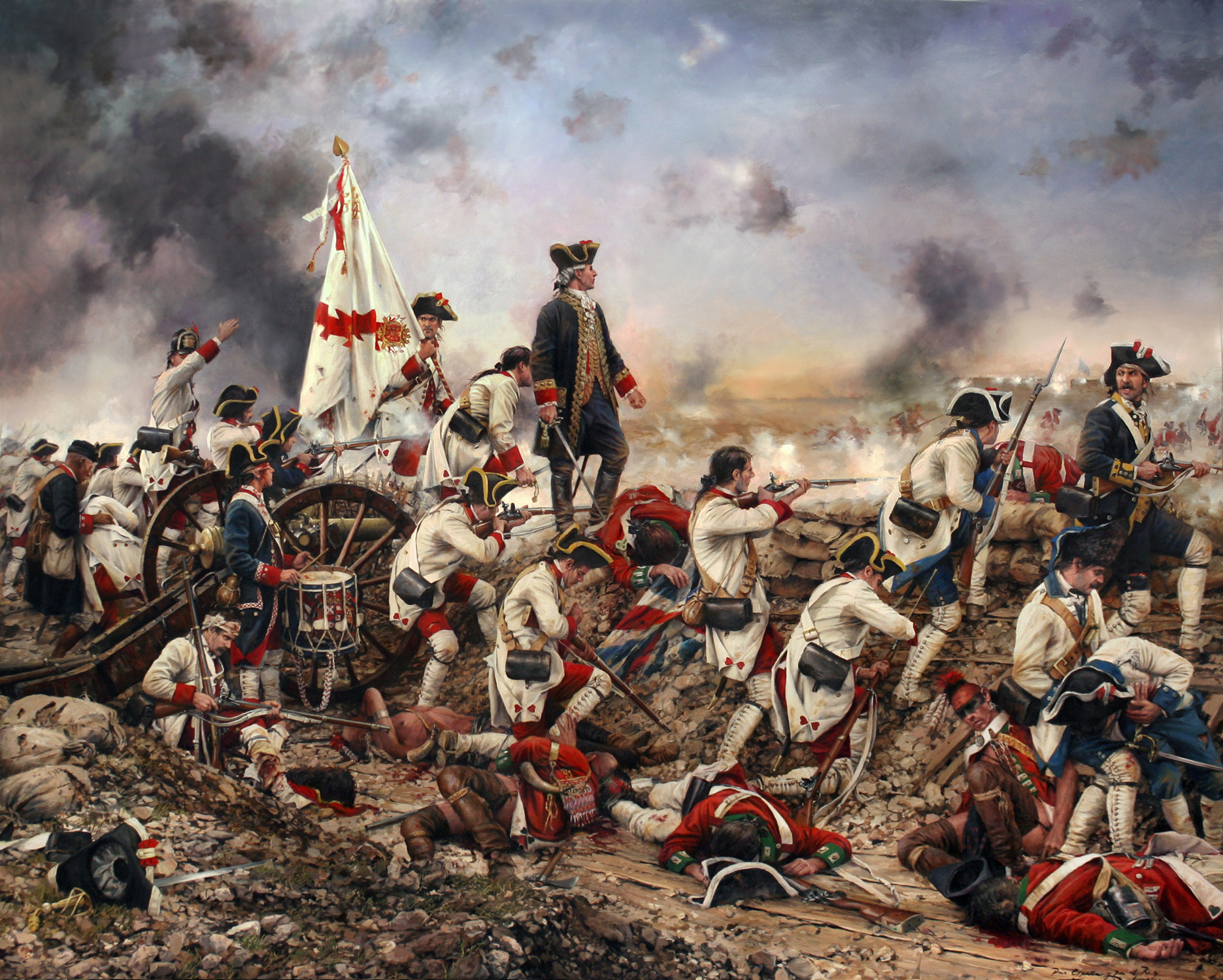
Augusto Ferrer-Dalmau’s 2015 painting, Por España y por el Rey, Gálvez en América, offers another route into this history. The Museo del Ejército describes the work as recreating Spanish forces repelling a British attack during the battle. A modern historical painting is an interpretation, however meticulously researched; it is not an eyewitness photograph. Viewers should examine composition, gestures and the relationship between commander and soldiers. Who attracts attention, and who remains anonymous? Such questions turn appreciation into visual literacy. The image can stimulate historical curiosity, provided that its emotional force is considered alongside written evidence and the circumstances of production.
08 · Recognition, memory and your own judgement
Gálvez later became viceroy of New Spain and died in 1786. His name endures in Galveston, Texas, while American recognition acquired a legal expression much later: honorary United States citizenship was granted by legislation approved on 16 December 2014. That date corrects the frequently repeated claim that the honour came in 2015. Remembering him should encourage a broader account of independence, including the people and resources behind military success. For an advanced English learner, the challenge is similar: weigh evidence, qualify conclusions and explain relationships. Not only should we recover overlooked contributions; we should also scrutinise how they are celebrated.
Three ideas to carry forward
- Independence had an international dimension: supplies, diplomacy and competing imperial interests mattered.
- Leadership depended on collective effort: “Yo solo” must be interpreted alongside the diary’s supporting vessels.
- Memory needs evidence: a painting, a slogan and a law answer different questions.
Sources, thanks & evidence trail
Thank you to Mariano Galindo for bringing this episode to a wider audience in his Vozpópuli article of 1 October 2026. His report inspired this original English learning task. Additional sources help clarify the crossing, surrender chronology and honorary citizenship date.
- Mariano Galindo · read the original Vozpópuli article.
- Real Academia de la Historia · Spain and the independence of the United States. Explore the chronology, documents and people behind Spanish assistance.
- Gálvez’s campaign diary · English transcription hosted by the University of Chicago. Entries for 18–19 March document the vessels and subsequent convoy; May entries distinguish terms and ceremony. Library of Congress · original Spanish diary record.
- US National Park Service · Gálvez and the Gulf campaign. Read alongside the diary: brief institutional summaries can simplify complex events.
- Public Law 113-229 · honorary citizenship, approved 16 December 2014. The law provides the authoritative date.
- Museo del Ejército · the Ferrer-Dalmau painting and its depicted episode. Artist’s foundation · Augusto Ferrer-Dalmau. Open image, attribution and licence record.
Editorial checks: Gálvez was 34 during the siege, not when first appointed governor. “Yo solo” describes initiative, not a crewless voyage. The convoy followed on 19 March; the formal surrender ceremony was on 10 May. Yorktown did not instantly end all fighting. Honorary citizenship dates to 2014. The museum and podcast briefings below are fictional practice scripts, not historical recordings.
You are learning to emphasise, compare, interpret and recommend. Each structure below serves one of those purposes. The examples are language models; speculative examples are not additional historical findings.
Grammar checkpoints: 0 / 10 understood.
01 · Negative inversion · give an idea emphasis
Why use it?
Use inversion to emphasise an addition, a restriction or an important warning. Its value comes from emphasis and precision, not from making every sentence sound formal.
Build it step by step
- Start with ordinary order: Gálvez led the crossing and also inspired the troops.
- Move not only to the front: Not only…
- The simple past has no visible auxiliary, so add did.
- Place did before the subject and change led to the base form lead.
- Complete the parallel addition: Not only did Gálvez lead the crossing, but he also inspired the troops.
Hear it · notice it · rebuild it
Not only should we recover overlooked contributions; we should also scrutinise how they are celebrated.
Under no circumstances should a motto be treated as a passenger list.
Only after checking the diary did the editor revise the caption.
Spanish bridge / Ayuda en español
Al colocar una expresión negativa o restrictiva al principio, invertimos auxiliar y sujeto. Con pasado simple, añadimos did y usamos el verbo sin marcar el pasado: did lead, no did led.
Common error: Not only Gálvez led the crossing. / Not only did Gálvez led the crossing.
Repair: Not only did Gálvez lead the crossing.
C1 precision note: Do not invert when not only modifies the subject itself: “Not only Gálvez but also his officers contributed.” With only after, inversion occurs in the main clause, not inside the after phrase.
Transfer: create a new sentence about the exhibition using this structure. Change the content, then check that its meaning and grammar still match.
02 · Inverted conditionals · analyse alternatives carefully
Why use it?
Use formal inverted conditionals to discuss unreal past alternatives, tentative future situations or remote possibilities. A counterfactual is an interpretation, not evidence that its imagined result actually occurred.
Build it step by step
- Past alternative: If he had waited, the operation might have stalled.
- Remove if and move had before the subject: Had he waited, the operation might have stalled.
- Possible future instruction: If visitors should ask, refer them to the diary.
- Formal version: Should visitors ask, refer them to the diary.
- Remote hypothesis: Were the museum to omit the sources, its display would be less convincing.
Hear it · notice it · rebuild it
Had he waited indefinitely, the operation might have stalled.
Had the convoy not entered, the troops might have faced further difficulties.
Should visitors ask about the motto, show them the diary.
Were the museum to omit the diary, visitors would lose an important comparison.
Spanish bridge / Ayuda en español
Had equivale a if + pasado perfecto; should introduce una eventualidad; were + to expresa una hipótesis remota. No añadas if a la versión ya invertida. En una condición negativa, not va después del sujeto.
Common error: If had he waited… / Had not he waited… / Had he would have waited…
Repair: Had he waited… / Had he not waited…
C1 precision note: Had + past participle is the conditional clause. Would/could/might have + past participle belongs in the result. Might signals a possible outcome rather than certainty.
Transfer: create a new sentence about the exhibition using this structure. Change the content, then check that its meaning and grammar still match.
03 · Modal perfects · separate possibility from certainty
Why use it?
C1 historical writing needs careful control of confidence. Different modals express different judgements about past events.
Build it step by step
- Identify the time: the judgement concerns a past event.
- Choose the intended confidence: may/might for possibility; must for a strong inference; cannot for an inference of impossibility.
- Add have, followed by the past participle.
- For a passive event, insert been: may have been delayed.
- Check whether your claim is documented, inferred or merely possible. Label it appropriately.
Hear it · notice it · rebuild it
The convoy may have been delayed by weather.
The officers must have considered the risks carefully.
The 2015 painting cannot have been an eyewitness record made in 1781.
The setback could have ended the expedition, but another attempt followed.
Spanish bridge / Ayuda en español
May/might have expresa posibilidad pasada; must have expresa una deducción fuerte; cannot have expresa una deducción de imposibilidad. Must have no significa obligación pasada: para eso suele usarse had to.
Common error: The convoy may had been delayed. / The painting cannot has been contemporary.
Repair: The convoy may have been delayed. / The painting cannot have been contemporary.
C1 precision note: Must have is still an inference, not proof. Could have may describe a possible alternative or an opportunity that did not materialise; context decides.
Transfer: create a new sentence about the exhibition using this structure. Change the content, then check that its meaning and grammar still match.
04 · Concession and contrast · connect competing ideas
Why use it?
Explain why cooperation can coexist with different aims, or why a painting can be useful despite limitations. Choose the connector according to meaning and grammar.
Build it step by step
- A complete clause has a subject and verb: the allies had different aims.
- Use although with a clause: Although the allies had different aims, they cooperated.
- Use despite with a noun phrase or gerund: Despite differing aims, they cooperated.
- Use whereas to compare two contrasting facts: The diary is contemporary, whereas the painting is modern.
- Use however between sentences, with appropriate punctuation: The painting is modern. However, it remains useful for discussion.
Hear it · notice it · rebuild it
Although the allies cooperated, their political aims differed.
Despite differing ambitions, Spain and France worked together.
The diary records operations, whereas the painting interprets a scene.
The painting is not contemporary. Nevertheless, its composition deserves analysis.
Spanish bridge / Ayuda en español
Although y whereas necesitan una oración con sujeto y verbo. Despite e in spite of van con nombre o forma en -ing. However y nevertheless conectan ideas; no los pegues a dos oraciones completas separadas solo por una coma.
Common error: Despite they had different aims, they cooperated. / Despite of their aims… / Although their aims differed, but they cooperated.
Repair: Despite having different aims, they cooperated. / In spite of their aims… / Although their aims differed, they cooperated.
C1 precision note: Even though presents a concession treated as factual. Even if introduces a hypothetical condition: “Even if the image were removed, the diary would remain available.” These are not interchangeable.
Transfer: create a new sentence about the exhibition using this structure. Change the content, then check that its meaning and grammar still match.
05 · Conditions and restrictions · make recommendations precise
Why use it?
A museum proposal should specify the conditions under which an interpretation or display is acceptable. Distinguish conditions from exceptions and precautions.
Build it step by step
- Name your recommendation: The image can be used.
- Add a positive condition: provided that the caption identifies its date.
- For a formal noun construction, use subject to: Approval is subject to checking the caption.
- For an exception, use unless: Do not publish the label unless its sources have been checked.
- Use in case for a precaution taken because something might happen: Keep the diary available in case visitors ask.
Hear it · notice it · rebuild it
The display will be effective provided that its sources are clear.
Approval is subject to checking every date.
Do not publish the caption unless its attribution is complete.
Keep a printed source list in case the internet connection fails.
Spanish bridge / Ayuda en español
Provided that introduce una condición. Subject to lleva nombre o -ing porque to es preposición. Unless significa if not: evita duplicar la negación. In case expresa precaución; no es un simple sustituto de if.
Common error: Approval is subject to check the dates. / Do not publish unless the sources are not checked.
Repair: Approval is subject to checking the dates. / Do not publish unless the sources are checked.
C1 precision note: In ordinary future conditions, use present forms rather than will in the condition: “We will open the display provided that the labels are ready.”
Transfer: create a new sentence about the exhibition using this structure. Change the content, then check that its meaning and grammar still match.
06 · Passive voice and reporting · foreground the evidence
Why use it?
Use the passive when the event, document or recipient matters more than the agent. Add the agent when attribution is relevant; do not hide who made a disputed claim.
Build it step by step
- Active: The legislation granted Gálvez honorary citizenship in 2014.
- Passive: Gálvez was granted honorary citizenship in 2014.
- Keep the tense in be: was granted is past simple passive; had been granted is past perfect passive.
- Reporting pattern: The convoy is reported to have entered on the following day.
- To combine reporting and a past passive: The position is reported to have been occupied after the explosion.
Hear it · notice it · rebuild it
Honorary citizenship was granted in 2014.
The commander is believed to have accepted considerable risks.
The diary records that supporting vessels followed him.
According to the diary, the convoy entered the following day.
Spanish bridge / Ayuda en español
La pasiva se forma con be y participio; el tiempo se marca en be. En is believed to have…, have + participio sitúa el hecho antes del momento de la creencia o del informe. Atribuye la información cuando la fuente importe.
Common error: Citizenship was grant in 2014. / The commander is believed have crossed.
Repair: Citizenship was granted in 2014. / The commander is believed to have crossed.
C1 precision note: “Is believed” does not identify who believes it or make it reliable. In evidence-based writing, “According to the diary…” is often clearer than an anonymous reporting passive.
Transfer: create a new sentence about the exhibition using this structure. Change the content, then check that its meaning and grammar still match.
07 · Relative clauses · add context without losing control
Why use it?
Relative clauses let you identify a place, add background about a person or comment on a whole preceding proposition. Punctuation changes the role of the information.
Build it step by step
- Identify the noun: The document that records the crossing is useful. This defining clause selects a document.
- Add extra information about an identified person: Gálvez, who led the campaign, later became viceroy.
- Use commas for the non-defining addition. Do not use that in this pattern.
- Refer to a whole proposition with which: The diary lists supporting vessels, which complicates a literal reading of the motto.
- Check the reference: does which mean a document, a vessel or the fact that has just been stated?
Hear it · notice it · rebuild it
The document that records the crossing deserves close reading.
Ferrer-Dalmau, whose painting appears above, reconstructs a historical scene.
The diary mentions supporting vessels, which challenges a literal reading of the motto.
Spanish bridge / Ayuda en español
La relativa especificativa identifica y no lleva comas; la explicativa añade información y lleva comas. Whose expresa posesión. Which puede referirse a toda una idea anterior; asegúrate de que el referente sea claro.
Common error: Gálvez, that led the campaign, became viceroy. / Ferrer-Dalmau, who painting appears above…
Repair: Gálvez, who led the campaign, became viceroy. / Ferrer-Dalmau, whose painting appears above…
C1 precision note: You may omit the relative pronoun when it is an object in a defining clause: “the document we consulted”. You cannot omit a subject pronoun: “the document that records…”
Transfer: create a new sentence about the exhibition using this structure. Change the content, then check that its meaning and grammar still match.
08 · Participle clauses · compress information safely
Why use it?
Use participle clauses to connect background circumstances or sequence without repeatedly stating the same subject. Compression works only if the implied subject remains clear.
Build it step by step
- Start with full clauses: After Gálvez had crossed the bay, he continued the operation.
- Both clauses refer to Gálvez, so compression is possible.
- Write: Having crossed the bay, Gálvez continued the operation.
- For a passive earlier action: Having been checked against the diary, the caption was revised.
- Read the main subject immediately after the comma: it must be the subject implied by the opening phrase.
Hear it · notice it · rebuild it
Having examined the diary, the editor revised the caption.
Pursuing their own objectives, the allies nevertheless cooperated.
Having been checked against the law, the citizenship date was corrected.
Spanish bridge / Ayuda en español
El sujeto implícito de la cláusula de participio debe coincidir con el de la principal. Having + participio indica anterioridad. Si quien consulta es el editor, no pongas el museo o la pintura como sujeto principal.
Common error: Having examined the diary, the painting seemed more dramatic.
Repair: Having examined the diary, the curator reconsidered the painting’s interpretation.
C1 precision note: The wrong version implies that the painting examined the diary. This is a dangling modifier. Restore a full clause if the relationship is difficult to express clearly.
Transfer: create a new sentence about the exhibition using this structure. Change the content, then check that its meaning and grammar still match.
09 · Cleft sentences · place the focus where it belongs
Why use it?
Cleft constructions highlight a selected element: a cause, an action or the evidence that matters. Use them to guide the reader through a contrast.
Build it step by step
- Ordinary statement: Collective effort made the victory possible.
- Focus the cause: It was collective effort that made the victory possible.
- Focus a need: What the caption needs is clearer attribution.
- Focus an action: What the editor did was compare the motto with the diary.
- Check meaning: a cleft emphasises an element; it does not justify an exaggerated claim.
Hear it · notice it · rebuild it
It was collective effort that made the victory possible.
What the diary provides is a detailed account of the operation.
What visitors need is a clear distinction between evidence and interpretation.
Spanish bridge / Ayuda en español
Las oraciones hendidas resaltan una parte concreta. It was…that permite enfocar un elemento; What…is presenta aquello que queremos destacar. No conviertas el énfasis gramatical en una afirmación histórica sin pruebas.
Common error: It was collective effort what made victory possible.
Repair: It was collective effort that made victory possible.
C1 precision note: Keep agreement and tense under control. With a plural focus, natural alternatives include “What visitors need are clear source labels” and “Visitors need clear source labels”. Choose clarity over unnecessary complexity.
Transfer: create a new sentence about the exhibition using this structure. Change the content, then check that its meaning and grammar still match.
10 · Hedging, nominalisation and register · write like a careful curator
Why use it?
Advanced writing balances precise vocabulary with visible evidence and readable sentences. Qualification should clarify the strength of a claim, rather than make every sentence vague.
Build it step by step
- Overclaim: Pensacola alone won American independence.
- Calibrate the claim: Pensacola contributed to a wider international struggle.
- Name the evidence: The diary records supporting vessels.
- Nominalise only when useful: “the recognition of his contribution” can connect ideas, but “the law recognised his contribution” names the actor more clearly.
- Finish by asking whether every qualification reflects a real uncertainty. Keep documented dates direct.
Hear it · notice it · rebuild it
The evidence suggests a more complex account of leadership.
Spanish assistance contributed to weakening British strategic options.
The law was approved on 16 December 2014.
A modern painting can support discussion, but it does not independently establish the events depicted.
Spanish bridge / Ayuda en español
Matiza las interpretaciones, pero expresa con claridad los hechos documentados. Suggest no significa demonstrate. Contributed to va con nombre o -ing. Una nominalización puede dar cohesión, pero el exceso de nombres abstractos oculta quién hace qué.
Common error: The evidence suggests of a broader role. / Spain contributed to weaken Britain. / The law might perhaps possibly have been approved in 2014.
Repair: The evidence suggests a broader role. / Spain contributed to weakening Britain. / The law was approved on 16 December 2014.
C1 precision note: Distinguish suggests, supports, indicates and demonstrates. Stronger verbs require stronger evidence. Avoid stacking might, perhaps and possibly when one qualifier is enough.
Transfer: create a new sentence about the exhibition using this structure. Change the content, then check that its meaning and grammar still match.
Your C1 grammar map
| What you want to do | Useful pattern | Watch out for |
|---|---|---|
| Emphasise an addition | Not only did + subject + base verb | No second past ending after did |
| Imagine an unreal past | Had + subject + participle; might have + participle | No if in the inverted version |
| Express past uncertainty | may have / may have been + participle | Possibility does not establish a fact |
| Make a concession | although + clause; despite + noun / -ing | No despite of |
| Set a condition | provided that + clause; subject to + -ing | To may be a preposition |
| Report earlier action | is reported to have + participle | Name the source when it matters |
| Add background | non-defining who / which / whose | Commas; no non-defining that |
| Compress two actions | Having + participle, subject + verb | Both clauses must share a subject |
| Focus an element | It was…that; What…is | Do not mix the two constructions |
| Qualify an interpretation | The evidence suggests…; contributed to + -ing | Do not over-hedge documented facts |
Your guided synthesis · a curator’s paragraph
Model: Although Gálvez led the crossing, the diary records supporting vessels. Not only does this evidence qualify a literal reading of the motto, but it also draws attention to collective effort. Having compared the diary with the painting, visitors can distinguish contemporary testimony from later interpretation. The display would therefore be effective provided that its captions identify each source clearly.
Analyse the model / Análisis guiado
Although introduce una concesión. Not only does… exige inversión; qualify va en forma base porque does ya marca persona y tiempo. Having compared comparte sujeto con visitors. Provided that introduce la condición necesaria para que la exposición funcione.
Now transfer: write four sentences about the painting, the citizenship law or the RAH resource. Include one concession, one inversion, one participle clause and one condition. This is open writing: use the explanations and checklist to review it.
These notes are saved on this device when storage is available and included in your learning report.
The 36-challenge History Quest
Check each answer individually. Explain your reasoning before opening a hint. Your first attempt is recorded once; corrections earn recovery XP without rewriting that score. Case, surrounding spaces and final punctuation are ignored.
Transformations: use 3–6 words including the unchanged key word. Use full forms. The open-cloze and word-formation items require ONE word. These practice items use one point each.
Reading · inference
Reading · the RAH resource
Reading · primary evidence
Reading · chronology
Reading · art and evidence
Reading · accuracy
Lexical precision · choose ONE
Open cloze · ONE word
Word formation
Key word transformations · 3–6 words
Gapped text · four gaps, one unused sentence
Choose the best linking sentence for each gap. Use A–D once each; E is unused. The full sentence is selected as your answer.
Listening · museum briefing
Museum briefing
Reveal practice transcript
Our exhibition uses Ferrer-Dalmau’s painting to prompt curiosity, but the label must distinguish the date of the artwork from the date of the battle. Please retain the full painting and credit the artist. For the crossing, compare the motto with the campaign diary, which records supporting vessels. The next priority is to check every date and source link before the display opens.
Fictional educational briefing. Browser-generated English speech.
Listening · history podcast
History podcast briefing
Reveal practice transcript
The episode should explain why Spanish assistance mattered without claiming that one commander won American independence alone. Yorktown belongs in the narrative, but the peace agreements of 1783 must also be mentioned. Our final section will correct the honorary citizenship date to 2014. I recommend ending with a question about how public memory selects its heroes.
Fictional educational briefing. Browser-generated English speech.
Your mission summary
Printable answer key · open after attempting the task
- To broaden the explanation of American independence. — The writer widens the frame to include strategy, supplies and allies.
- The military, diplomatic and logistical dimensions of Spanish assistance. — Paragraph 2 uses the Academy’s resource to connect military action with diplomacy, commerce and supplies.
- It records supporting vessels, so the motto should not be read literally. — The diary records two launches and a sloop; initiative, not physical solitude, is the distinction.
- Explosion, capitulation terms, formal ceremony. — The explosion occurred on 8 May; terms followed; the formal ceremony took place on 10 May.
- As a modern interpretation to examine alongside written evidence. — Paragraph 7 treats composition and emotion as material for analysis, while retaining written evidence.
- Honorary citizenship was approved in 2014; peace agreements followed the war in 1783. — Paragraph 8 gives 16 December 2014, while paragraph 6 distinguishes Yorktown from the peace agreements of 1783.
- imperial — Imperial relates to an empire; imperious describes an overbearing manner.
- undermined — Undermine means weaken or compromise.
- eyewitness — An eyewitness account records events witnessed directly; the diary is contrasted with a later painting.
- set — Set an example is the conventional collocation.
- qualify — Qualify a conclusion means limit or refine its scope.
- coincide — Coincide means correspond or occur together; here it refers to matching aims.
- did — Fronted not only requires auxiliary–subject inversion: did + subject + base verb.
- have — Might have + past participle expresses a possible counterfactual past result.
- into — Take something into account means consider it.
- in — In spite of is followed by a noun phrase or gerund.
- that — Provided that introduces a condition expressed as a clause.
- in — There is little point in + gerund is the standard pattern.
- disruption — Disruption is the abstract noun required after serious.
- interpretation — The article a and adjective literal require a singular noun.
- cooperation / co-operation — Cooperation is the noun describing working together.
- credibility — Credibility is the quality of being believable.
- historical — Historical means relating to history; historic means historically momentous.
- leadership — Leadership denotes the capacity or practice of guiding others.
- may have been delayed — May have been + past participle gives a passive possibility about the past.
- only did Gálvez lead / only did Galvez lead — Negative fronting requires did + subject + lead; the key word ONLY remains unchanged.
- had he waited — Invert the third conditional by removing if and placing had first.
- the date into account — The object the date goes between take and into account.
- under no circumstances should the motto / under no circumstances must the motto — Fronted under no circumstances requires auxiliary–subject inversion.
- provided that evidence / providing that evidence / on condition that evidence — These conditional connectors preserve only if and include unchanged THAT.
- A. That setback required renewed preparation. — That setback refers to the hurricane and connects it with renewed preparation.
- B. The distinction prevents a literal reading of the slogan. — The distinction connects supporting vessels with the qualification of the slogan.
- C. Its visual choices nevertheless deserve analysis. — Nevertheless preserves the value of visual analysis despite the limitation just stated.
- D. This event did not end every theatre of the war. — This event refers to Yorktown and explains the later peace date.
- Checking dates and source links. — The briefing explicitly identifies checking every date and source link as the next priority.
- A question about how public memory selects heroes. — The speaker recommends closing with a question about public memory and its selection of heroes.
Final mission · a C1 museum proposal
A local museum is preparing an exhibition titled Spain and American Independence: Beyond the Slogan. Write a proposal of 220–260 words recommending three exhibits or interpretive features. Include Ferrer-Dalmau’s painting, a primary source and evidence from the RAH resource. Explain how visitors will distinguish individual leadership, collective effort and later commemoration. Use headings, a conditional, controlled inversion and appropriate qualification.
0 words · target 220–260
Writing scaffold
Purpose: “The purpose of this proposal is to…” Interpretation: “The diary indicates…, whereas the painting…” Condition: “The display would be effective provided that…” Recommendation: “Not only should visitors encounter…, but they should also…”
Self-review · not automatic marking
Tick each item only after checking your draft. Writing quality is not automatically scored.
Go on reading · choose your next mission
Keep your curiosity moving: professional English, exam practice, space or emergency aviation.
 From Olive Grove to Europe · Professional English LabExplore your next mission →
 Model 110 · PAGS exam practiceExplore your next mission →
 Model 105 · Space and PAGS practiceExplore your next mission →
 Fireline Pilots · C1 Emergency AviationExplore your next mission →
Use the blog’s Followers gadget to join.
Go on reading
Choose your next mission. Keep your report, review an error tomorrow, and continue exploring.


No hay comentarios:
Publicar un comentario