13 jun 2026

Daniela's success.

Daniela's Success! - NeuroEnglish for You
Daniela studying happily

Daniela's Success!

By NeuroEnglish for You!

¡Hola, Daniela!

Tu cerebro es increíble y está diseñado para aprender. Hoy vamos a dominar el futuro en inglés paso a paso. Tienes pistas, sonidos, esquemas y muchos ejemplos. Pasa el ratón sobre el texto azul para ver traducciones mágicas. ¡Tú puedes con esto!

1. Present Continuous (Citas y Planes Fijos)

¿Por qué usamos algo de "presente" para hablar del futuro? ¡Porque el plan es tan seguro que es como si ya estuviera pasando! Lo usamos para arrangements (acuerdos, citas, billetes comprados).

Fórmula Mágica (El Puzzle):

Persona + am / is / are + Verbo-ING + Cuándo

Conjugación Completa (Verbo: Work)

Persona Afirmativa (+) Negativa (-) Interrogativa (?)
I (Yo)I am workingI am not workingAm I working?
You (Tú)You are workingYou aren't workingAre you working?
He (Él)He is workingHe isn't workingIs he working?
She (Ella)She is workingShe isn't workingIs she working?
It (Eso)It is workingIt isn't workingIs it working?
We (Nosotros)We are workingWe aren't workingAre we working?
They (Ellos)They are workingThey aren't workingAre they working?

They're visiting the museum tomorrow.Ellos van a visitar el museo mañana (ya tienen las entradas compradas).

He isn't playing computer games this afternoon.Él no va a jugar a videojuegos esta tarde (ya ha quedado para otra cosa).

Is she posting her pictures soon?¿Va a publicar ella sus fotos pronto? (¿Lo tiene planeado?)

Entrenamiento - 10 Frases

Tip: Fíjate en el sujeto. Si es singular (The museum, He, Daniela) usa "is". Si es plural (We, They) usa "are".

1. The technology museum a film tomorrow.
2. I a new keyboard this weekend.
3. We to London on Friday.
4. Daniela her teacher at 5:00.
5. We coding next week.
6. My computer tomorrow. It's broken!
7. I to the party tonight.
8. Where next Sunday?
9. the printer soon?
10. What time tomorrow?

2. Will (Predicciones y Magia)

A diferencia de la agenda segura, WILL es como adivinar el futuro. Son predicciones sobre lo que creemos que pasará, promesas u opiniones.

Fórmula Mágica (El Puzzle):

Persona + WILL (o WON'T) + Verbo Normal (sin "to")

Conjugación Completa (Verbo: Go)

Persona Afirmativa (+) Negativa (-) Interrogativa (?)
I (Yo)I will go ('ll go)I will not go (won't go)Will I go?
You (Tú)You will goYou won't goWill you go?
He (Él)He will goHe won't goWill he go?
She (Ella)She will goShe won't goWill she go?
It (Eso)It will goIt won't goWill it go?
We (Nosotros)We will goWe won't goWill we go?
They (Ellos)They will goThey won't goWill they go?

Drones will replace post workers.Los drones sustituirán a los carteros (yo lo creo, pero no es seguro al 100%).

We won't drive cars in 30 years.No conduciremos coches dentro de 30 años. (won't = will not)

Entrenamiento - 10 Frases (Sigue la bola de cristal)

Tip: Recuerda que WILL es igual para TODAS las personas. ¡No hay que cambiar nada!

1. I think most objects internet connections.
2. The fridge food automatically.
3. A 3D printer people's meals.
4. Virtual reality more common than TV.
5. People keyboards. (Usa won't)
6. We with a pen anymore.
7. The robot mistakes.
8. the program work on my PC?
9. How in 2050?
10. robots have feelings?

3. Be going to (Intenciones y Evidencias)

Es el punto intermedio. Es tu intención firme o lo usamos cuando vemos que algo es inminente por las evidencias físicas.

Fórmula Mágica (El Puzzle de 4 piezas):

Persona + am/is/are + GOING TO + Verbo Normal

Conjugación Completa (Verbo: Drive)

Persona Afirmativa (+) Negativa (-) Interrogativa (?)
II am going to driveI am not going to driveAm I going to drive?
YouYou are going to driveYou aren't going to driveAre you going to drive?
HeHe is going to driveHe isn't going to driveIs he going to drive?
SheShe is going to driveShe isn't going to driveIs she going to drive?
ItIt is going to driveIt isn't going to driveIs it going to drive?
WeWe are going to driveWe aren't going to driveAre we going to drive?
TheyThey are going to driveThey aren't going to driveAre they going to drive?

We're going to buy a laptop.Vamos a comprar un portátil (estamos ahorrando).

Look at those clouds. It is going to rain.Mira esas nubes. Va a llover (evidencia visual clara).

Entrenamiento - 10 Frases (Enciende la bombilla)

Tip Frecuente: ¡No te olvides del verbo 'To Be' (am/is/are) delante de 'going to'!

1. Liam maths this afternoon.
2. I a movie tonight. (Ya sé cuál).
3. Look at the clouds! It soon.
4. They my house later.
5. Liam and John computer games.
6. She this summer.
7. I that phone.
8. Mia a technician?
9. you the game?
10. What they now?

4. First Conditional (Causa y Efecto probable)

La primera condicional es para advertencias o consejos. Algo que es muy probable que pase.

Fórmula de la Balanza:

If + Persona + Presente Simple
, ➡️
Persona + WILL + Verbo Normal

If I reuse boxes, I will help the environment.Si reutilizo cajas (causa en presente), ayudaré al medio ambiente (efecto en futuro).

Unless we pick up rubbish, animals will eat it.A menos que recojamos la basura, los animales se la comerán.

Entrenamiento - 10 Frases (Equilibra la balanza)

Tip: Si ves la palabra "If", ¡ese lado NUNCA lleva Will! El "Will" va en la otra mitad de la frase.

1. If she the boxes, we her.
2. If it tomorrow, I at home.
3. If you hard, you the exam.
4. If we the river, the fish .
5. The fish if we don't clean the river.
6. I angry if you late again.
7. She to the party if she is tired.
8. Unless you , you won't pass. (If you don't study).
9. Unless we , we will miss the bus.
10. I will not help her unless she me. (Ojo: she lleva 's' en presente).

5. Listening & Reading Time! (Expanded)

British Audio Task

Escucha a Sarah (audio largo) y responde las 10 preguntas.

Presiona play para escuchar

Daniela's London Trip

Daniela is very excited because she is travellingella va a viajar (seguro) to London next month. She has her plane tickets and her hotel reservation ready! In London, she is going to visitella tiene la intención de visitar lots of famous places like Big Ben, the London Eye, and the British Museum. She is saving up money because she is going to buy souvenirs for her family.

She thinks the weather will be coldserá frío (predicción/opinión) and rainy, so she will pack a big coat, warm sweaters, and a colourful umbrella. Daniela loves technology, so she is going to spend a full day at the Science Museum. She hopes she will see the new interactive displays.

Her English teacher told her: "If you practiceSi practicas (condición) your English every day, you will understandentenderás (resultado) everyone easily in London." Daniela knows this is true. "Unless I studyA menos que estudie / Si no estudio, I won't be able to order fish and chips!" she laughs.

On Sunday morning, she is meeting her British friend, Sarah, for tea. They are going to have a great time catching up. Daniela believes this trip will be the best experience of her life. What will happen next? We will see!

Mega Quiz: 30 Preguntas Finales

¡Demuestra lo increíble que es tu cerebro! Lee con calma (Agenda, Bola de Cristal, Bombilla, Balanza). Dale al botón verde al final.

```

29 may 2026

103. PAGS MOCK EXAM: The AI Revolution Smart Teaching Tech. The human and the machine.

NeuroEnglish Social - Task 103: AI in Language Teaching

NeuroEnglishY2

SEASON 2
Artificial Intelligence Concept
Imagen de libre uso
2º AÑO PAGS

The AI Revolution
Smart Teaching Tech

"Task 103: The Human & The Machine"

@NeuroEnglishMMP

🤝

Entorno 100% Neuro-Inclusivo

Este examen está adaptado metodológicamente para cuidar de tu cerebro en este Segundo Año. Incluye herramientas específicas para TDAH, Dislexia y Ansiedad ante exámenes. ¡Céntrate en brillar, nosotros nos ocupamos del resto! ✨

Year 2: Roadmap

01
Context
AI in Education
02
Reading
UNIA & UMA Master
03
Quiz
16 Questions
04
Listening
Ethical Risks
05
Glossary
Tech Terms

Las 4 Claves del Examen 103

El Máster

Identifica a las instituciones promotoras: UNIA y UMA y su objetivo de integrar IA en idiomas.

Ventajas Clave

Busca los beneficios mencionados en el texto: la inmediatez y el ahorro de tiempo al crear materiales.

Riesgos Éticos

Cuidado con el vocabulario técnico: "biases" (sesgos) y "hallucinations" (alucinaciones de la IA).

El Factor Humano

Conclusión: la tecnología no puede sustituir el criterio ni el "ojo humano" del docente.

📚 Study Guide: Key Vocabulary Listen & Hover

Groundbreaking
Degree
Emerging
Immediacy
Biases
Hallucinations
Irreplaceable
Relying on
Natives
Lacks
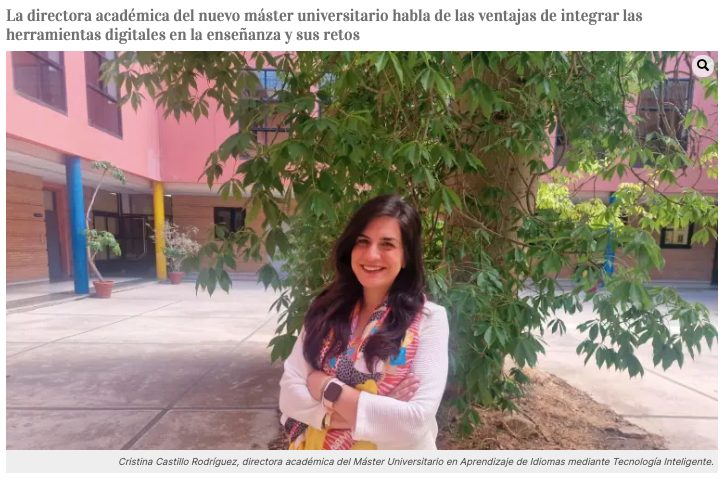
Cristina Castillo Rodríguez

Cristina Castillo Rodríguez

Directora Académica del Máster

Reading Analysis Y2

AI in Language Teaching

A groundbreaking Master's Degree in Language Learning through Smart Technology has been launched jointly by the International University of Andalusia (UNIA) and the University of Malaga (UMA). Academic Director Cristina Castillo Rodríguez explains that the primary goal is to train educational professionals to integrate artificial intelligence (AI) and digital tools into foreign language teaching.

A Comprehensive Approach

The program, offering 60 spots in its first year (which will expand to 100 later), is designed for all educational stages, from early childhood to Vocational Training (FP). It prepares future and current teachers to use emerging technologies not only to learn, but to create customized educational materials, design online content, and tutor in digital platforms.

The Double-Edged Sword of AI

While tools like ChatGPT and Gemini provide undeniable advantages, such as immediacy and saving significant time in resource creation, Castillo warns about the ethical challenges. "We must be extremely careful with ethical implications, biases, and AI hallucinations," she notes. Therefore, relying completely on technology without human supervision is a dangerous mistake. The teacher must always verify the accuracy of the content.

The Future Classroom

Ultimately, the new generation of digital natives requires adapted teaching rhythms and methods. However, Castillo emphasizes that technology will not replace educators.

The teacher remains absolutely irreplaceable. They are the ones who detect classroom needs, apply the correct methodology, and provide the critical "human eye" that artificial intelligence currently lacks.

Language Learning Concept

Integrating tech into modern language learning.

Fuente Original: Diario Jaén

Este texto ha sido adaptado con fines educativos a partir de una excelente entrevista original a Cristina Castillo Rodríguez.

Leer entrevista completa en Diario Jaén

Nuestro más sincero agradecimiento a Diario Jaén por su labor indispensable en la divulgación educativa y tecnológica.

PAGS ENGLISH EXAM - YEAR 2

Task 103 Mock Exam

16 preguntas nivel B1-B2. Concéntrate en la tecnología.

1. SUMMARY: What is the text mainly about?

2. Detail: Which universities are launching this program?

3. Detail: How many spots does the program offer in its first year?

4. Detail: What educational stages is this Master's designed for?

5. Detail: What specific AI tools are mentioned in the text?

6. Vocabulary: What does "immediacy" mean?

7. Vocabulary: What are AI "hallucinations"?

8. Grammar: "A Master's Degree has been launched..." What structure is this?

9. Grammar: "...not only to learn, but to create..." What is the function of "to create"?

10. Inference: Why is the human teacher "irreplaceable"?

11. Inference: What does the term "digital native" imply?

12. Detail: What is a specific risk of AI mentioned by Castillo?

13. Connector: "However, Castillo emphasizes..." What does "However" express?

14. Detail: Does the director think AI will replace teachers?

15. Vocabulary: "Groundbreaking" can be translated as...

16. Conclusion: What does the text say about AI and the "human eye"?

Year 2: The Expert's View

Track 103: Hallucinations in the Classroom

Listen to Mark, an EdTech specialist, talk about the risks of AI. (Duration: ~1:15)

1. Topic

What problem is Mark discussing?

2. Definition

What is an AI "hallucination" according to Mark?

3. Detail

What happens if a teacher relies blindly on the AI?

4. Detail

What must the teacher do with the material?

5. Inference

Does Mark think using ChatGPT is a bad idea?

6. Conclusion

Why is the human eye "irreplaceable"?

103-CRAFT: AI Vocabulary

SCORE: 0

¡Bienvenidos al 2º Año PAGS!

Hemos subido el nivel. Si te gusta esta nueva etapa, asegúrate de estar suscrito a las actualizaciones de @NeuroEnglishMMP.

Valora esta lección:

¡Gracias por apoyar el Año 2!

@NeuroEnglishMMP - YEAR 2 (Task 103)

Preparing for Global Awareness 2026