🎧 Opening audio: about 75 seconds · Hover or tap underlined language for Spanish support.
MISSION 01 · REFRAME THE LANDSCAPE
What if the largest classroom in Jaén has no walls?
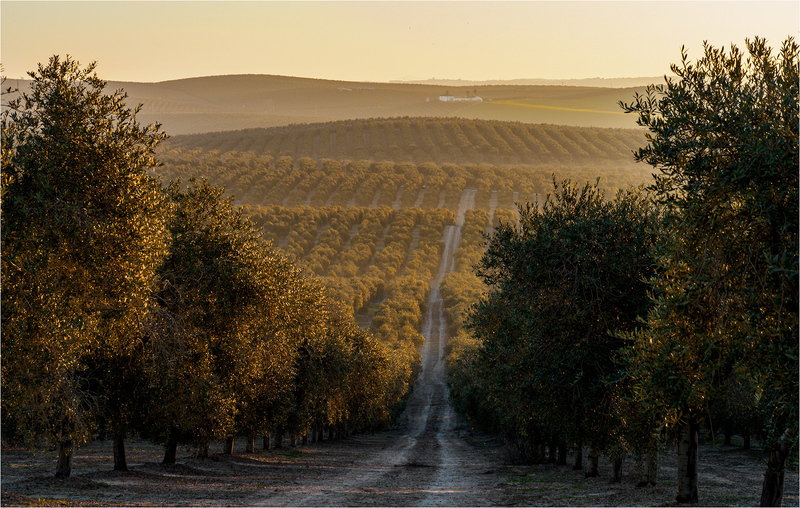
From a hilltop outside Jaén, the olive groves appear timeless. Yet beneath that familiar landscape lies a sophisticated value chain shaped by agronomy, mechanical engineering, food chemistry, sensory science, automation, logistics, branding and international trade.
Extra virgin olive oil—EVOO—is not merely extracted and bottled. Its quality must be protected at every stage. Fruit condition, harvest timing, transport, temperature, oxygen exposure, filtration, storage and traceability can all influence the final product.
This C1 journey asks you to think like a technician, communicate like an export professional and learn like an Erasmus+ participant. Your mission is to take a batch from the grove to a European buyer—without losing either its quality or your credibility.
🧠 C1 retrieval prompt: Before scrolling, predict six departments or occupations involved between harvesting an olive and selling a premium bottle abroad.
MISSION 02 · MASTER THE VALUE CHAIN
From fruit to finished product
🔊 Tap each stage. Then summarise the entire chain in no more than 45 seconds.
MISSION 03 · SEE THE MODERN MILL
This is industry, not nostalgia.
A contemporary olive mill may combine stainless-steel processing lines with sensors, automated control, laboratory testing and real-time production records. Digital systems can strengthen decision-making and traceability—but only when staff understand the process and question the data.
C1 distinction: Technology does not “guarantee” quality. It can support consistency, flag deviations, reduce avoidable losses and provide evidence for decisions.
Select a card: hear the word, read a C1 model sentence and shadow it aloud.
MISSION 05 · COMMUNICATE QUALITY RESPONSIBLY
Strong professionals distinguish evidence from marketing.
❌ Overclaim
“Our oil is perfect because we use the latest technology.”
✅ Evidence-based C1
“Our process is designed to minimise oxidation and preserve sensory quality; conformity is assessed through the applicable chemical and sensory controls.”
❌ Vague
“The olives are processed very quickly.”
✅ Measurable
“We record reception and milling times for each load and investigate any deviation from the internal target.”
Language lens: C1 credibility often comes from calibrated verbs—indicates, supports, is consistent with, may contribute to, is subject to verification—rather than dramatic certainty.
MISSION 06 · FIND YOUR PROFESSIONAL ROUTE
Jaén’s olive economy needs more than one type of expert.
⚙️
Production technician
Operates and monitors processing equipment, records parameters and responds to deviations.
English:handover · maintenance · safety · process reporting🔬
Quality technician
Coordinates sampling, documentation, laboratory results, hygiene and corrective actions.
Intermediate VET Diploma in Olive Oils and Wines develops skills related to raw materials, extraction and production operations, packaging, food safety, quality and workplace learning. Current curricula and regional provision must always be checked on the official portals.
A dashboard flags that one batch remained above the internal temperature target for longer than expected. Laboratory classification is not yet complete. A Dutch buyer asks whether the shipment will leave tomorrow as planned.
What you know
The process record shows a deviation.
The tank is isolated and identifiable.
Samples have been taken.
No final conclusion has been authorised.
What you must avoid
Hiding or minimising the deviation.
Declaring the batch defective without evidence.
Promising dispatch before release.
Sharing unsupported technical claims.
Choose the strongest response
MISSION 08 · EXPORT WITHOUT LOSING CREDIBILITY
Build a professional buyer update
C1 task: Add one sentence that anticipates the buyer’s likely concern without becoming defensive.
MISSION 09 · TAKE JAÉN TO EUROPE
Your Erasmus+ classroom could be a Portuguese lagar or an Italian frantoio.
Erasmus+ mobility can place VET learning inside companies and training organisations abroad. For an olive-oil learner, the European value lies in comparison: different cultivars, climates, mill configurations, quality systems, business models and visitor experiences.
Olive stones, pulp and vegetation water can present opportunities and environmental challenges. A credible circular strategy must consider technical feasibility, safety, regulation, transport, energy use, market demand and unintended consequences.
Advanced English challenge: “To what extent can circularity improve competitiveness without shifting environmental impacts elsewhere?”
FINAL C1 CHALLENGE · RETRIEVE AND APPLY
The Jaén-to-Europe Quality Mission
Ten decisions. Instant feedback. Your first attempt earns XP.
🏆
Mission completed
C1 PORTFOLIO TASK · 90 SECONDS
Pitch Jaén to a European placement host
Your task: Explain what you already understand about the olive-oil value chain, which competence you want to develop abroad and what knowledge from Jaén you can contribute.
Mandatory language:whereas · provided that · from a quality standpoint · a key trade-off · subject to verification
01:30
Record yourself on your phone. Repeat once tomorrow, reducing hesitation while preserving precision.
Educational content reviewed in September 2026. Training provision, mobility destinations, market rules and product requirements can change. Verify decisions with the relevant official body, school, employer or competent authority.
ROOTED IN JAÉN · READY FOR EUROPE
English is not outside your profession. It is how your profession crosses borders.
🎧 Intro audio: about 55 seconds · Tap highlighted words for Spanish.
MISSION 01 · SEE THE PURPOSE
English is not another subject. It may be the language of your first winery abroad.
Spain’s wine map is also a map of careers. Behind every harvest, bottle and tasting room, there are growers, laboratory technicians, cellar workers, export managers, guides and sommeliers. They need science, technology, hospitality—and languages.
In this learning journey, you will move from the vineyard to the winery, and from Spanish VET to a possible Erasmus+ placement. You will learn to describe wine responsibly, understand production, solve workplace situations and introduce yourself to a European employer.
🧠 Neurotip: Predict first. Write down three English words you expect to use in a winery. At the end, retrieve them without looking.
MISSION 02 · BUILD YOUR MAP
From grape to glass: the production chain
🔊 Tap a stage to hear a professional sentence.
MISSION 03 · SPEAK LIKE THE SECTOR
Your Wine English toolkit
Choose a card. Listen, read the model and say it aloud.
MISSION 04 · READ THE WINE MAP
Award-winning regions become a language lesson
Recent reader-voted Guía Vinos Gourmets awards offer a useful journey through Spanish wine geography: Rioja for barrel-fermented white, rosé and aged red; Ribera del Duero for young red; Penedès for sparkling wine; Rueda for Verdejo and Bierzo through the work of acclaimed winemaker Raúl Pérez.
Storytelling, guided visits, digital marketing, logistics, negotiation and communication with international customers.
And what about sommelier training? HOTR0209 Sommelier is listed in TodoFP as a Level 3 professional certificate under the previous plan. Always check the current regional offer and transition rules before applying. Check the official record.
MISSION 06 · GO ERASMUS+
Your learning could cross a border
Erasmus+ can support VET learners and recent graduates in work-based learning abroad. Placements may take place in a company, a training centre or another relevant organisation. Your school applies and organises the mobility: students do not apply directly for the grant as individuals.
Cellar master: Welcome, Alex. Before we start, could you tell me about your training?
Alex: Certainly. I am studying Viticulture in Spain. I have practised quality control, sensory analysis and basic cellar operations.
Cellar master: Good. This morning we are checking a batch that is fermenting in stainless steel tanks. What would you monitor?
Alex: I would monitor temperature, density and hygiene, record the results and immediately report any deviation.
Cellar master: Excellent. Safety first. If you are unsure, ask before acting.
Shadowing: listen to one line, pause, copy its rhythm, then record yourself on your phone. Comparing—not perfection—builds awareness.
MISSION 08 · TASTING-NOTE BUILDER
Build a precise, responsible description
A crisp white with citrus and green-apple aromas, lively acidity and a clean finish.
FINAL CHALLENGE · RETRIEVE, DON'T REREAD
Wine Career Challenge
Choose an answer. Instant feedback explains why. Your first attempt earns XP.
🏆
Mission completed!
CONTINUE YOUR JOURNEY
Your next stop: Vineyard Passport
You now understand the sector and its career routes. Continue with our related viticulture article to deepen your technical vocabulary and travel further through the world of the vineyard.
Educational article · Sources checked September 2026 · Programme availability and mobility destinations can change; confirm details with the relevant school and official portal.
🍇 English grows when you use it for something real.
Follow NeuroEnglish for You!
New English missions for VET, PAGS and Bachillerato—built around real industries, real careers and real Europe.
Your old phone has a future. Could your English — and your career — have one here too?
C1 PRACTICE EXAMINDUSTRY GAMEFP DUAL / VETERASMUS+
Historical project photograph, September 2025: Atlantic Copper. This image does not show current operating status.
Time left80:00
Objective score0 / 80
XP0
Best streak0
Mission briefing · Start here
Not rubbish. A resource waiting for expertise.
This is a feature article, an independent C1 practice challenge and a guide to industrial careers. Explore a real project in Huelva, practise critical reading, and connect English with the skills that keep complex plants running.
EN: Choose Learning mode for translations and flexible listening. Choose Challenge mode before starting for hidden translations and two plays per listening. Mark all six sections, write 220–260 words, then review your errors. ES: En modo aprendizaje tienes traducciones y audios libres. En modo reto se ocultan las traducciones y dispones de dos escuchas por listening. Corrige las seis secciones, redacta 220–260 palabras y repasa tus errores.
Suggested main mission: 80 minutes (reading 12, language 15, listening 12, careers 8, writing 30, checking 3). Vocabulary games and follow-up work are extra. Timing is optional and never deletes answers. Browser-generated speech requires a compatible device. No microphone or account needed.
Assessment note: 40 objective items × 2 = 80 points; teacher-assessed writing adds up to 20. This is a C1-oriented learning resource, not an official exam, a validated CEFR placement test or an employment assessment.
01 · Read the evidence
02 · Decode C1 language
03 · Listen and infer
04 · Build your next step
Prediction lab · 60 seconds
Before you read: what arrives at the gate?
Imagine the delivery trucks at CirCular. What is inside? Make a prediction; do not look it up yet.
Learning principle: Predict → read → check. Generating an answer gives you a question to resolve. A wrong prediction can become useful learning when followed by feedback.
The feature · Huelva / Europe · Editorial snapshot: 13 September 2026
The next mine might already be in your drawer
Original English educational feature, informed by José Luis Losa’s report in El Confidencial, 13 September 2026, and the primary sources linked below. The source article was supplied for this adaptation.
1 · A drawer full of unfinished stories
Somewhere in your home, an old phone is probably enjoying an unusually long retirement. Its screen may be cracked; its battery may be exhausted. Yet the materials inside have not necessarily become worthless. The device has reached the end of one useful life, not the end of every possible use for its metals. That distinction lies at the heart of urban mining: recovering valuable materials from products that society has already manufactured.
In Huelva, Atlantic Copper is preparing to give that idea industrial scale through CirCular. According to the supplied El Confidencial report, the project represents an investment of €550 million and an initial processing capacity of 60,000 tonnes of material a year. Its inauguration is scheduled for Monday, 14 September 2026. But a ribbon-cutting ceremony and a plant running at full capacity are not the same event. The report describes testing followed by a gradual ramp-up, rather than instant stable production.
€550mreported project investment
60,000 tannual input capacity planned initially
≈350direct, indirect and induced jobs forecast
Not yetproof of full-capacity operation
2 · Not a giant blender for smartphones
Contrary to what a hurried headline might suggest, whole laptops and televisions are not expected to arrive ready to be thrown into a furnace. Authorised waste operators first dismantle and process discarded equipment. CirCular receives selected non-ferrous metal-bearing fractions. Their composition matters: the treatment of a material cannot sensibly be planned without knowing what it contains.
The report distinguishes two main areas. In MRS, incoming material is received, reduced in size, sampled and analysed. The TSL area contains the secondary smelting furnace, which produces copper-bearing intermediate materials for further treatment within the existing complex. Recovery is therefore a chain of specialist operations, not a magical single-step conversion. Nor does 60,000 tonnes of input mean 60,000 tonnes of pure recovered metal. Capacity, throughput and recovery yield describe different things.
According to the report, a possible later phase could raise capacity to 80,000 tonnes annually and add further metal-processing facilities. These are proposed expansions, not a description of equipment already operating. In industrial journalism, the difference between “will”, “could” and “has” is much more than a grammar exercise.
MRS construction image, 2025. Receiving material is only the beginning: sampling and characterisation come before treatment. Source: Atlantic Copper.Heat-recovery boiler installation, July 2025. A large project brings together process engineering, maintenance and environmental systems. Source: Atlantic Copper.
3 · Europe’s resource problem is also a skills problem
The appeal is not merely environmental. Recovering metals within Europe may help diversify supply chains that depend heavily on external suppliers. The European Commission’s Critical Raw Materials Act sets 2030 benchmarks for EU capacity: extraction equivalent to 10% of annual consumption of strategic raw materials, processing equivalent to 40%, and recycling equivalent to 25%. These are EU-wide capacity benchmarks, not recovery targets imposed on each household or on this one plant. Read the Commission’s explanation.
Recycling does not, however, make a process automatically harmless. Transport, energy demand, emissions and residues still need careful management. A credible circular-economy argument therefore asks not only whether a metal can be recovered, but under what conditions, with what trade-offs, and with what independently checkable results. Accountability belongs beside innovation, not beneath it.
A circular economy needs more than a second life for materials. It needs a first opportunity for well-trained people.
4 · The opportunities behind the headline
The report’s forecast of approximately 350 jobs includes direct, indirect and induced employment. It should not be read as 350 immediate vacancies on one company’s payroll. The practical question for a student is more specific: which tasks require which skills? Process operation, laboratory analysis, maintenance, automation and environmental monitoring all contribute to an industrial plant’s performance. A machine can be expensive; a misunderstood instruction can be expensive too.
There is a real link with vocational education. In a July 2025 announcement, Atlantic Copper reported incorporation rates of 88% for Industrial Chemistry and 90% for Industrial Mechatronics among the relevant FP Dual pathways since 2017. Those company-reported historical figures are encouraging, but they are not national graduate-employment rates, current vacancy counts or a guarantee for a future applicant. Read the original company statement.
The strongest career preparation combines technical knowledge with precise communication. Describing a fault, clarifying a tolerance, checking a sample label or handing over a shift are language tasks as well as workplace tasks. English should not become a decorative subject attached to practical training. It should help the learner explain what has happened, what remains uncertain and what must happen next.
5 · A placement is a learning agreement, not a postcard
A well-designed Erasmus+ traineeship can extend that preparation abroad. Its value lies in learning outcomes: using technical documentation, observing a different quality system, communicating with a supervisor and reflecting on differences in working practice. A famous destination is less important than meaningful tasks, supervision and recognition.
For an applicant, the next step is manageable. Compare relevant programmes, check entry requirements, ask the centre about company-based training, and contact its international coordinator. Ask what the grant covers, what you may have to pay yourself and how the placement will be assessed. No brochure can remove every uncertainty. Good preparation can make those uncertainties visible — and help you decide what to do about them.
Newsroom check: This article preserves the reporting date. It does not announce that tomorrow’s inauguration has already happened. The industrial explanations are educational summaries, not instructions for operating equipment or recycling electronics at home.
Visual process map · Think in stages
From end-of-life equipment to another use
01Pre-treatment
Authorised operators dismantle equipment and prepare suitable fractions.
02MRS
Receive, sample and characterise material before treatment.
Integration with the existing complex allows subsequent processing.
Simplified educational sequence based on the supplied report. The photographs and process links are historical reference material.
Open the company’s detailed process illustrationCompany illustration: Atlantic Copper media resources. Use the source page if the external image does not load.
Exam 1 · Reading · 16 points
Read beyond the headline
Choose the answer best supported by the feature. Distinguish fact, forecast, implication and limitation.
Exam 2 · Use of English · 24 points
Precision is your most valuable tool
C1 toolkit:Not until… did… · Had it not been for… · despite… · is expected to… · provided that…. Notice how grammar changes the strength and timing of a claim.
Memory workshop · Optional practice, no exam points
Recover the word before you reveal it
Look at the English term. Say its Spanish meaning and invent a workplace sentence. Then reveal the card. “Review later” puts it back into the deck.
Spacing plan: Recall five terms tomorrow, again in three days, and again next week. Mix familiar and difficult terms. Read less, retrieve more — then check accuracy.
Full bilingual glossary · 24 useful terms
Exam 3 · Vocabulary in context · 10 points
Five words. Five costly misunderstandings.
Stay curious · Halfway checkpoint
Tick the follow button!
Free English with a practical purpose. Follow NeuroEnglish for You! for C1 challenges, PAGS, FP Dual and Erasmus+ learning. Hazte seguidor/a: inglés gratuito conectado con el mundo real.
You hear an operations manager brief a new trainee. Why does she resist pressure to increase output? Read questions 26–30, then listen twice. Default rate: 0.85.
Original fictional training script. It is not an Atlantic Copper recording or an account of an actual incident.
The inauguration may attract attention, but tomorrow's photographs will not tell us whether the process is stable. We are still checking how the equipment behaves under different conditions. Yesterday's sample results were useful, although one reading did not agree with the others. The laboratory repeated the analysis rather than quietly removing the inconvenient number. That was the right decision. Our immediate priority is reliable information, not a higher tonnage on the dashboard. A supplier has confirmed that the missing spare component will arrive on Thursday. Even so, we have not promised a restart at a particular hour. Delivery is only one condition; the maintenance team must also complete its checks. As a trainee, you will update the observation log with your supervisor. You will not adjust operating settings independently. If an instruction seems ambiguous, ask for it to be clarified and repeat back your understanding. Silence is not evidence of understanding. We can explain a cautious timetable. We cannot justify pretending that an unresolved issue has disappeared. When you write your handover, distinguish what you observed from what you think caused it. The next team needs both, clearly labelled. Confidence is useful only when it rests on evidence.
Exam 5 · Listening 2 · 10 points
The Erasmus+ interview
You hear a candidate explain what she hopes to learn during a placement. Listen for priorities, reservations and implied meaning. Read questions 31–35 first.
Original fictional interview, not a confirmed vacancy, destination or Erasmus+ partnership.
At first, I chose the destination because a friend had enjoyed living there. Then my tutor asked what I expected to learn. I realised that an attractive city was not a learning outcome. I am studying laboratory analysis and quality control, so I now look for a placement where I can practise sample traceability, work with technical documentation and receive structured feedback. I would not expect unrestricted access to a plant simply because I can speak English. The host would need to assess my competence and explain the boundaries of my role. Before accepting, I would want the learning agreement to identify a supervisor, specific tasks and a way to assess my progress. The grant is important, but I have not assumed it will cover every expense. I am preparing a budget for accommodation, local transport and the period before the first payment. My main concern is not making a grammatical mistake. It is understanding an instruction only approximately and being too embarrassed to ask. I have therefore been practising clarification phrases with a classmate. After returning, I would like to produce a bilingual handover template for our laboratory. That would turn an individual experience into something the next group could use. A successful placement should leave more behind than photographs.
Career lab · From the classroom to the plant
Which kind of problem would you like to solve?
These are relevant training pathways, not a list of current CirCular vacancies. Actual roles depend on recruitment, experience and employer training. The links lead to official course or centre information.
Further study for eligible graduates: connecting maintenance with data and digital tools. Check accepted entry qualifications.
“The trend suggests deterioration, but further evidence is needed.”
PAGS / access route: An entrance examination can be one route to Higher VET. Check the current regional call and the professional families linked to the examination you pass. This C1 English challenge is not a PAGS examination or a requirement for admission. See the access information on the official TodoFP course pages.
FP Dual connects learning with a real workplace. Photograph and historical employment figures: Atlantic Copper, July 2025. Participation does not guarantee recruitment.
Start locally. Compare nationally.
Huelva · CPIFP Profesor José Luis Graíño
In Palos de la Frontera–La Rábida, the centre lists Industrial Chemistry, Laboratory Analysis and Quality Control, Industrial Mechatronics and Automation, among other pathways. Its website also publishes Erasmus+ information for both Grado Medio and Grado Superior.
The Industrial Chemistry course page lists dual training and Erasmus placements abroad. Ask the centre for current places, selection criteria and host arrangements; a general mobility offer is not a guaranteed industrial placement.
Want to study elsewhere in Spain? Use TodoFP’s regional centre finders to search every autonomous community, Ceuta and Melilla. Compare the exact qualification, teaching language, equipment, timetable, travel costs, company-training arrangements and Erasmus opportunities. This is a selected starting point, not an exhaustive national directory.
What will it cost?
No verified 2026–27 fee quotation for these individual programmes is included here. Request a written total from each centre. Separate tuition or applicable public charges from materials, protective equipment, transport, accommodation and expenses during placements. Ask which costs the centre or host provides and which are yours. Do not assume that “public”, “dual” or “Erasmus+” makes every associated expense disappear.
Employment: Monitor Atlantic Copper’s recruitment portal and your centre’s placement office. Build a portfolio with a sample report, a fault description and a short English handover. These are suggested application materials, not employer requirements.
Erasmus+ · More than a trip
Take your skills abroad. Bring something useful back.
For Spanish Higher VET students, the higher-education mobility route may be relevant; Grado Medio uses the VET framework. Your centre must confirm the applicable project, selection rules and eligibility. Start with European Commission traineeship guidance and SEPIE, Spain’s national agency.
AskWhich project covers me? Who selects applicants?
AgreeTasks, supervisor, outcomes and recognition.
PrepareBudget, language, insurance and accessibility.
TransferBring back a usable resource for your class.
Your placement briefing: six questions worth asking
Will my work involve meaningful technical learning rather than unrelated routine tasks?
Who will supervise me, and how often will I receive feedback?
Which tasks may I observe, assist with or perform under supervision?
What are the grant amount, payment schedule and likely personal costs?
What support is available for disability, accessibility or other inclusion needs?
How will my learning be assessed and recognised when I return?
Suggested host profiles, not confirmed vacancies: an analytical laboratory, an industrial maintenance team, an authorised recycling business or an automation specialist. Ask your coordinator to verify suitability and availability. No partnership between the named centres and a foreign employer is claimed here.
Model enquiry email · Use it as a language scaffold
Dear International Coordinator,
I am interested in an Erasmus+ traineeship related to industrial chemistry, maintenance or materials recovery. Could you confirm which mobility route applies to my qualification and whether our current partners offer supervised technical tasks?
I would also appreciate information about selection criteria, the learning agreement, grant payments and recognition. My aim is to improve my technical communication and return with a bilingual resource that other students can use.
Kind regards, [Your name and course]
Bonus simulator · Not real plant data
Capacity is not production. Try the numbers.
This simplified calculation uses hypothetical inputs. It does not model CirCular’s actual performance or metal composition.
5,400 t
Hypothetical recovered metal/year
Formula: 60,000 tonnes input capacity × utilisation × metal content × recovery yield. Assumes constant composition and yield; ignores real process complexity. Explain aloud why increasing input alone does not establish purity, profitability or environmental performance.
Exam 6 · Evidence and career literacy · 10 points
Would you trust the claim?
Writing · 30 minutes · 20 teacher-assessed points
The skills behind the green transition
Write an article of 220–260 words for a college careers website. Explain how industrial VET and international placements could help young people contribute to the circular economy. Assess two practical measures the college should prioritise and recommend one first step. Distinguish promising opportunities from guaranteed outcomes.
Plan: an engaging opening → two developed arguments → one limitation → a justified recommendation. Use at least two ideas from the feature without copying its sentences.
0 words · target 220–260
Your writing stays on this page unless you choose “Save on this device”. No text is submitted to a teacher or an AI. Saving is local to this browser and origin, not cloud synchronisation.
Teacher rubric · Five criteria, 0–4 each
For each criterion: 0 = absent; 1 = limited; 2 = partly effective; 3 = effective with minor weaknesses; 4 = consistently effective.
Task: audience, two measures and a justified first step.
Ideas: developed reasoning, evidence and appropriate caution.
Organisation: coherent paragraphs and natural cohesion.
Language: precise vocabulary and flexible complex structures.
Control: accurate grammar, spelling and appropriate register.
This is a classroom rubric, not an official awarding-body scale. Keep a self-estimate separate from teacher assessment.
After writing: compare with a model (not an answer to memorise)
A second life needs a skilled first step
A discarded phone is an unlikely careers adviser. Yet the metals it contains point towards a question colleges can no longer ignore: who will operate, maintain and monitor the industries expected to recover them?
The first priority should be meaningful partnerships between vocational programmes and employers. A visit can inspire students, but repeated, supervised practice enables them to connect theory with decisions. Laboratory learners need to understand why traceability matters; maintenance students need opportunities to explain a fault, not simply name a component. Colleges should therefore agree specific learning outcomes and review them with workplace supervisors.
A second measure is to integrate technical English with international placements. An Erasmus+ experience becomes educationally valuable when learners must clarify instructions, interpret documentation and reflect on unfamiliar working practices. Preparing a bilingual handover template after returning could also benefit classmates who did not travel.
Nevertheless, neither a new factory nor a mobility grant guarantees employment. Industrial projects take time to reach stable operation, while placements vary in quality and may involve personal costs. Careers guidance must make these limitations explicit rather than burying them beneath optimistic headlines.
The most realistic first step is a small joint project: one vocational group, one employer and one clearly assessed technical task. It would give teachers evidence of what students can do and learners evidence of what they still need to practise. The green transition deserves that kind of practical ambition.
Speaking extension · Pair work · Ungraded
The boardroom challenge
Student A: You represent a college seeking industrial placements. Student B: You are a workplace supervisor concerned about preparation and safety. Discuss which learning outcomes you can realistically agree. Reach a decision in four minutes.
Useful caution
It would be premature to assume that… Provided that supervision is available…
Useful clarification
Could you clarify what you mean by…? Would it be fair to say that…?
Mission debrief
Turn mistakes into recoverable value
Mark all six objective sections first.
— / 80
Your score describes this task, not your overall CEFR level.
NEUROENGLISH FOR YOU!
SECOND LIFE METALS · Completion record
Independent C1-oriented practice. Not a language qualification or a professional licence.
Recovery round · Keep the original score honest
Your personal error bank
After marking, return to the items you missed. The second attempt earns practice XP, not extra examination points. Use the feedback, wait briefly, then try to retrieve the answer.
Exit ticket: Without looking back, explain (1) why 350 jobs does not mean 350 vacancies; (2) why capacity is not output; (3) which VET route interests you and what you will check next.
Editorial safeguards: no guaranteed job, admission, grant or overseas placement is claimed. No invented tuition price is supplied. Planned capacity is not realised annual production. All listening scenarios, examination questions and the numerical simulator are original educational material. This resource is not sponsored by, affiliated with or endorsed by the organisations named.