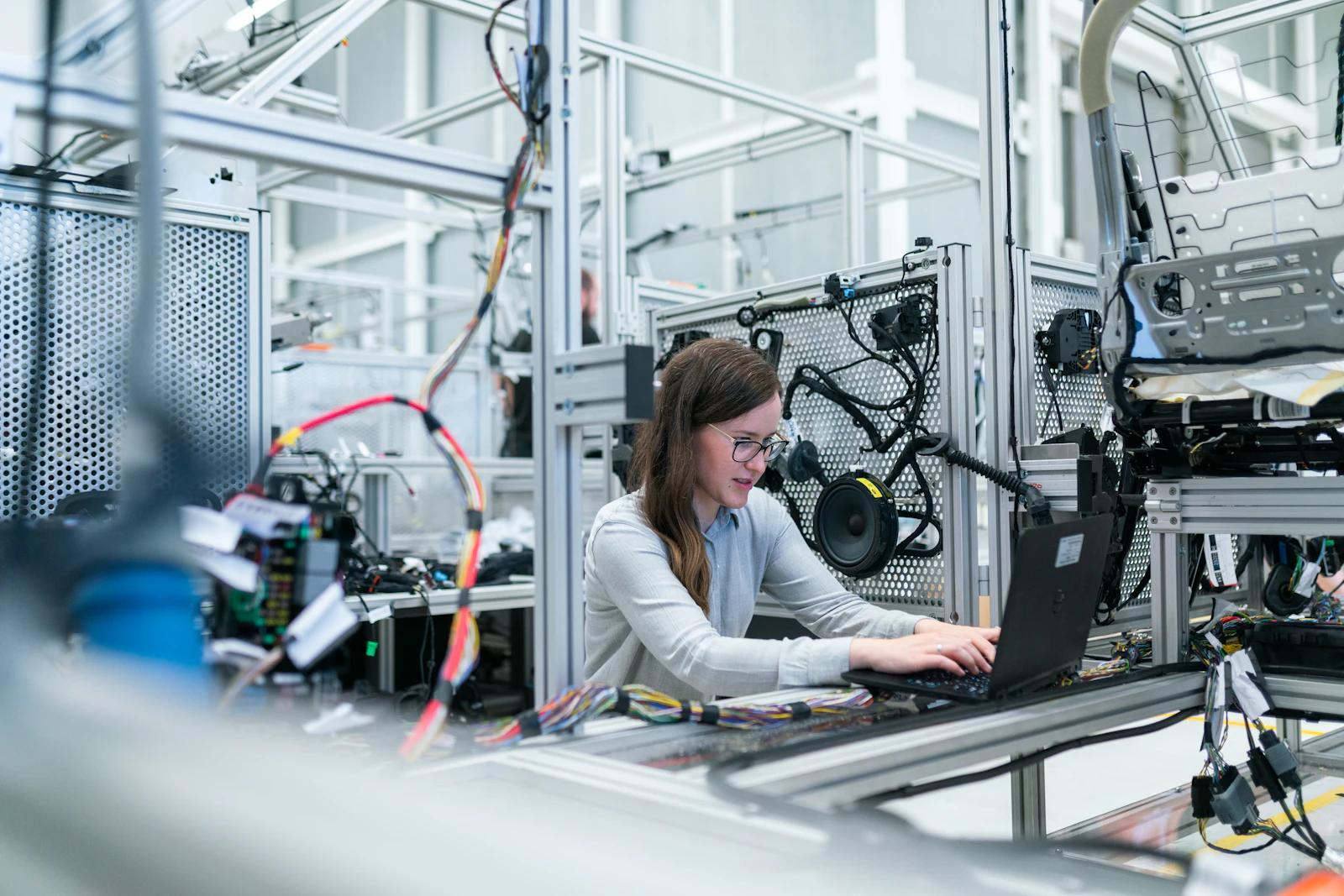
It is often claimed
that the defence industry exclusively recruits engineers and university graduates; however, recent data
suggests
that Vocational Training (VT)
profiles are becoming increasingly
essential.
According to a report published in March 2026 by
📰 Infodefensa,
the Spanish metal industry foundation —
Fundación del Metal para la Formación,
integrated by
Confemetal, CCOO Industria and UGT FICA —
has identified a
staggering
demand for up to
350,000 unfilled positions across the metal sector in the coming years.
This surge
is closely linked to the
Plan ReArmar Europa,
a European rearmament
initiative
endowed with
800 billion euros,
which is generating unprecedented
demand not only for engineers but also for mid-level and higher-level technicians
specialised in
electronics,
automation
and precision machining.
The two most
sought-after
profiles are presented below.
⚡
Higher Technician in Electrotechnical & Automated Systems
Participates in the
installation,
programming
and maintenance
of electrical and control systems
integrated into
land, naval and industrial platforms —
critical domains
in modern military programmes.
🔩
Machining Technician
Key in the
manufacturing
of high-precision parts
for armoured vehicles,
drones,
ballistic systems
and structural components, where
technical tolerance
is decisive.
The growing weight
of VT in the defence industry is far from
anecdotal.
In leading companies,
between 30% and 50% of the workforce
already comes from vocational backgrounds.
Furthermore, the
Dual VET model
proves particularly
effective:
students who complete it find employment at rates
four to eight percentage points higher
than those following
conventional pathways,
according to the Ministry of Education.
In structural terms,
Spain's defence industry
comprises
approximately 580 companies generating 33,000 direct jobs.
If the aerospace and security sectors are included,
employment rises above 75,000 positions,
concentrated mainly
in Madrid, Andalusia and the Basque Country.
The average salary
exceeds €2,000 net per month,
making these careers both
stable
and financially
rewarding.
As Héctor Aguirre,
coordinator
of the Fundación del Metal,
remarked:
young people do not always
associate
sectors like defence or space with the metal industry,
despite the fact that these are
cutting-edge
fields offering remarkable technological environments.
It is high time
we challenged
these misconceptions
and recognised VET as a genuine
engine
of Spain's industrial future.